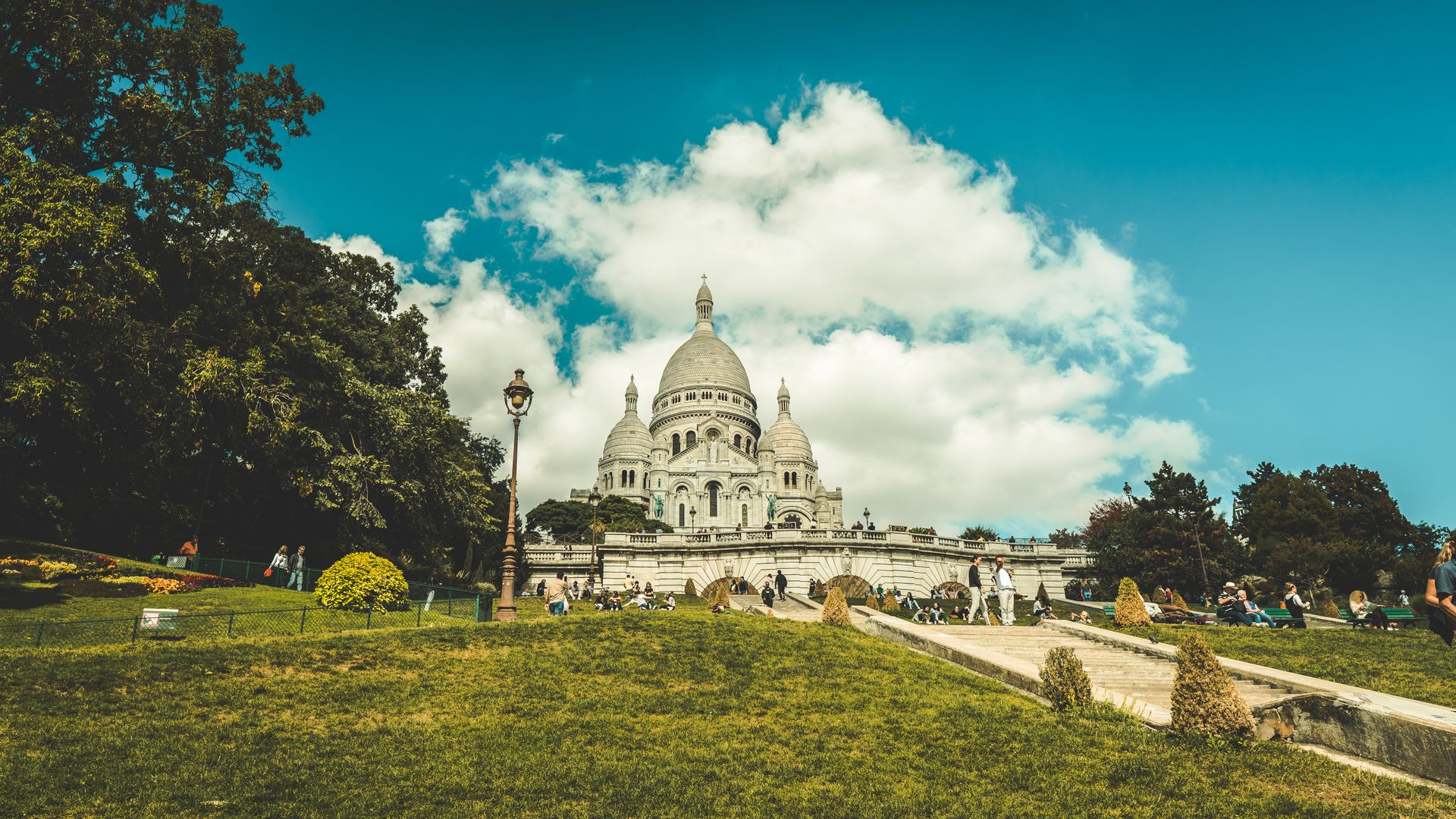
The white domes of the Sacré-Cœur above the rooftops, painters on Place du Tertre, the village streets of the Abbesses and Rue Lepic, a hidden vineyard and the red windmill of the Moulin Rouge — the 18th is Montmartre, the most romantic hill in Paris.
The hill of Montmartre rewards walkers — the Sacré-Cœur and its view, the painters of Place du Tertre, hidden vineyards and windmills, and the cabarets at the foot of the slope. A hand-picked selection, most with free cancellation.
Wind up the lanes of the hill with a local guide — the Sacré-Cœur, Place du Tertre, the vineyard and the haunts of the artists who made Montmartre famous.
Climb the 300 steps of the dome for the highest panorama in Paris — a 360° view from the top of the Butte, above the rooftops of the whole city.
The hill's story in its oldest house, with the Renoir gardens and a view over the vineyard — studios once used by Renoir, Valadon and Utrillo.
The legendary cabaret at the foot of the hill — feathers, sequins and the French cancan, with dinner or Champagne. Book well ahead.
Taste your way around the village — cheese, charcuterie, pastries and wine — on a guided walk through the foodiest corners of the hill.
The artists' square behind the basilica, where portraitists still work at their easels — have your portrait drawn, or just soak up the village atmosphere over a coffee.
The 18th is built around the Butte Montmartre — the highest natural point in Paris, once a village of vineyards and windmills outside the city walls. Below the hill stretch the Abbesses, Pigalle, the Goutte d'Or and the great markets of Barbès, a lively, multicultural slice of the city.
The white-domed basilica crowning the hill, with the best free panorama in Paris from its parvis. The 18th's unmistakable landmark.
The little square behind the basilica where painters still set up their easels — the historic heart of artists' Montmartre, once home to Picasso and Utrillo.
The most charming corner of the hill: its Art Nouveau metro entrance, café-lined Rue des Abbesses and the steep, cinematic Rue Lepic.
The last working vineyard in Paris (the Clos Montmartre) and the surviving windmills — the Moulin de la Galette and Moulin Radet — recall the village's rural past.
At the foot of the hill, the red windmill of the Moulin Rouge and the neon of Pigalle — birthplace of the cancan and of Belle Époque Paris by night.
The vibrant, multicultural east of the 18th — the bustling Marché Barbès, the fabrics of the Marché Saint-Pierre and a soundtrack of world cuisines.
From a Belle Époque brasserie to a village bistro behind the Sacré-Cœur, Montmartre eats with real character — historic addresses, terraces on the Abbesses and the smell of roast chicken on Rue Lepic.
A Montmartre institution since 1889 on the Rue des Abbesses — seafood platters, oysters and Auvergne specialities in a warm, bustling brasserie.
Chef Antoine Westermann's "bistro of beautiful birds" near the windmills — free-range poultry roasted to perfection, with a view over the hill.
A grand brasserie on Place de Clichy since 1892, famous for its oyster bar — once a haunt of Picasso, Apollinaire and Henry Miller.
A village bistro in the oldest corner of the Butte, where Van Gogh, Renoir and Pissarro once gathered — French terroir cooking and a leafy courtyard.
A tiny, legendary Montmartre address for cheese and meat fondue, wine served in baby bottles and elbow-to-elbow tables. Fun and unmistakably local.
A quintessential Abbesses café-brasserie with a buzzing terrace — homemade French dishes from breakfast to late, in the heart of the village.
A basilica with a view, a square of painters, a hidden vineyard and the most famous cabaret in the world — the places that make Montmartre unique.
The white travertine basilica at the summit of Montmartre (35 Rue du Chevalier de la Barre), with a vast mosaic of Christ and a panorama over all of Paris.
The artists' square behind the basilica, ringed by cafés, where portraitists and painters still work. Loveliest early in the morning.
The hill's history in its oldest house, with the Renoir gardens and a view over the Clos Montmartre vineyard. Once a studio for Renoir, Valadon and Utrillo.
The last working vineyard in Paris, on the corner of Rue des Saules and Rue Saint-Vincent — its harvest is celebrated each October at the Fête des Vendanges.
The most famous of Montmartre's surviving windmills, immortalised by Renoir — once an open-air dance hall, now a romantic survivor on Rue Lepic.
The world's most famous cabaret at the foot of the hill (Place Blanche), home of the French cancan since 1889 — book ahead for the evening revue.
The landmarks, viewpoints, museums and tables of Montmartre and its slopes. Click a marker — or a list item — to see what's there.
Paris is divided into 20 arrondissements that spiral outward clockwise from the centre, like a snail. The 18th is in the north, on the Right Bank, rising over the Butte Montmartre and spreading down to Pigalle, Barbès, the Goutte d'Or and the ring road at Porte de la Chapelle and Porte de Clignancourt.
It is a hill of two faces: the romantic, village-like Montmartre of the Abbesses and the Sacré-Cœur above, and the lively, multicultural quarters of Barbès and the Goutte d'Or below — together one of the most characterful corners of the city.
Since 2025 the system has been simplified: paper tickets are gone, replaced by the contactless Navigo Easy card or your phone. A single Métro/RER ticket is now a flat fare, and a day pass quickly pays for itself if you ride often.
For door-to-door directions, the Bonjour RATP and Citymapper apps are the most reliable companions.
Metro line 2 skirts the foot of the hill (Anvers, Pigalle, Blanche) and line 12 climbs into the village (Abbesses, Lamarck–Caulaincourt). Here are the essentials.
A few practical essentials to make your visit to the 18th arrondissement smooth and stress-free.
Montmartre is magical early in the morning and at sunset, when the crowds thin and the light is golden. Come in October for the Fête des Vendanges; the hill is busiest midday in summer.
Montmartre is steep and cobbled, with many stairs. Comfortable shoes make all the difference — or take the funicular up and wander down through the village lanes.
The Sacré-Cœur is free, but the dome climb, the Musée de Montmartre and the Moulin Rouge revue all benefit from booking online, especially in high season.
Cards are accepted almost everywhere; small cafés and market stalls may prefer cash. Service is included by law; rounding up for great service is appreciated, never expected.
Place du Tertre and the basilica steps draw pickpockets and pushy "bracelet" sellers. Keep bags zipped, decline politely and walk on — the quieter back lanes are the real Montmartre.
The basilica opens daily from early morning to evening; cabarets run nightly shows; many shops on the hill open late morning. The vineyard is viewable from the street year-round.
Compare stays, tours and experiences across the platforms travellers know best.
Each Paris arrondissement has its own guide. Hover the map to reveal a district's name, then click to open its dedicated site — you are currently in the 18th.